I Contain Multitudes
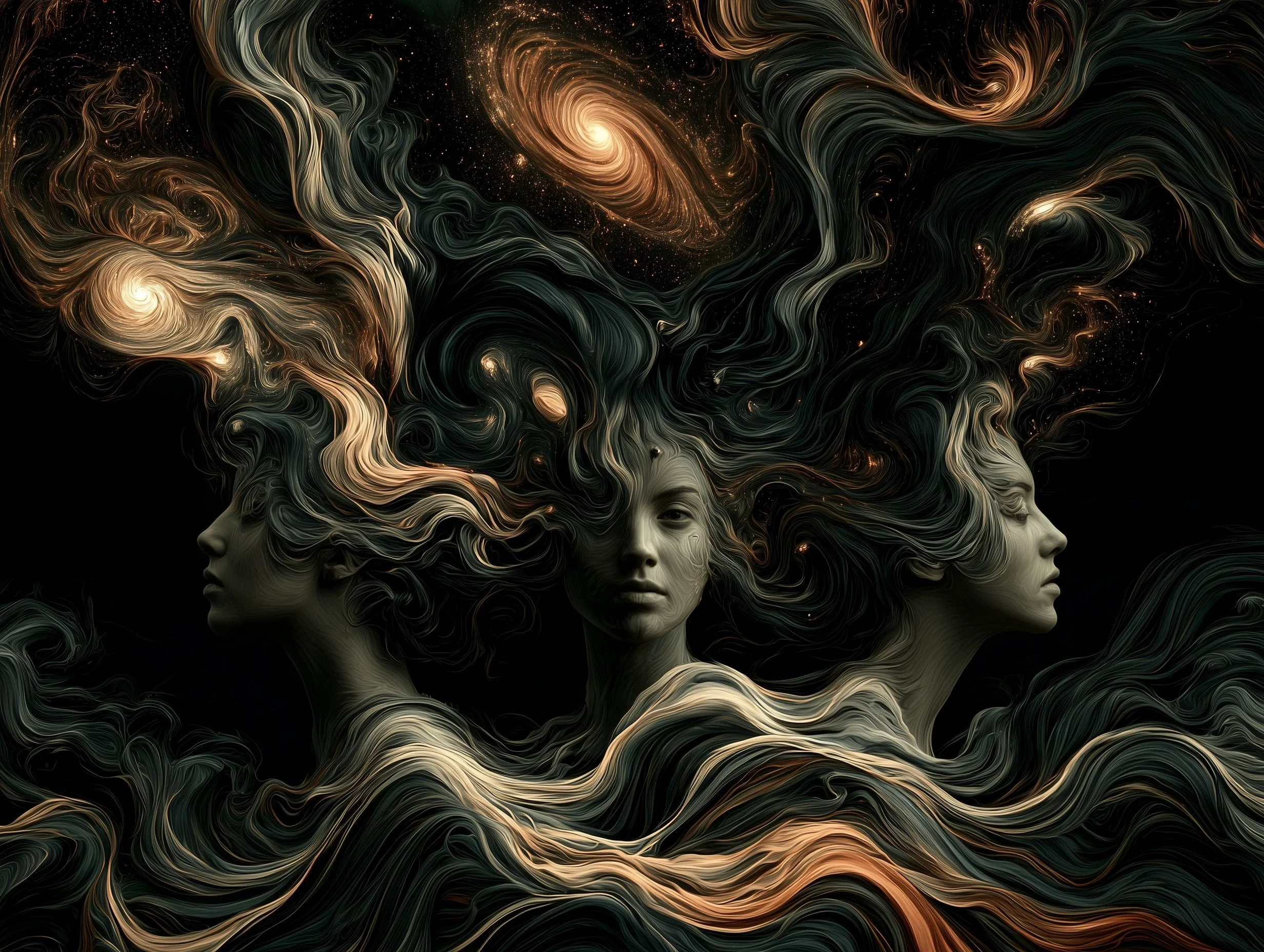
In the National Geographic documentary Gender Revolution, Katie Couric interviewed a group of college students about their gender and preferred pronouns. One student introduced themselves, "My name is Matthew and I am a junior. And I use they, them, theirs." Katie followed up and asked the group of college students, "What exactly does it mean to be they, them, theirs?" One response focused on the gender neutrality of "they" pronouns. "They" offers both a gender-neutral and gender-encompassing pronoun without committing to a binary "she" or "he" reference. However, what I found even more interesting was Matthew's response, who focused their response not on the neutrality, but on the plurality of the "they" pronoun. Matthew responded to Katie, "People are always saying 'Oh, but they is a plural pronoun. How can I refer to a single person that way?' In my head, I think I am plural. I contain multitudes."[1]
This example demonstrates a shift in personal identity. Adopting "they" pronouns is not only concerned with gender, but also plurality. There is a plurality of persons within a self who make "they" not only an acceptable pronoun, but perhaps a more accurate pronoun depending on your metaphysical view on personal identity. I argue that persons ought to be considered plural and our pronouns can appropriately reflect that plurality. I briefly address concerns of an immutable soul before demonstrating the plurality of persons physically, cognitively, and psychologically. Then I demonstrate how personal identity is both an individual and communal endeavor which not only makes our personal identity plural within ourselves, but also through interaction with others. Lastly, I briefly address concerns of "erasing gender" through "they" pronouns.
There is a plurality of persons within a single person. Personal identity is both an internal and external process which includes individuals and communities. It is sometimes argued that "they" pronouns cannot be used to signify a single individual, but I argue "they" pronouns can signify a single individual when there is a plurality of selves within a single person. If "they" is meant to signify a plurality of persons, then "they" is an appropriate pronoun for persons who consider their personal identity as plural.
I acknowledge and note that the premise that a person is plural is controversial. Some might be inclined to make an appeal that persons aren't plural due to an immutable, unchanging, immortal, eternal soul. If this is the case, then persons cannot be plural metaphysically. However, the argument from an immutable, unchanging, immortal, eternal soul is problematic for a few reasons. Understanding the nature of the soul, if it is undetectable, is highly problematic. For example, do souls think or change? If souls don't think or learn what do they do? What is the purpose of a soul? If souls do change, how do they change? Likewise, if they change, how are they different than our physical, cognitive, or psychological capacities? Why would someone be concerned with preserving an immutable, unchanged, eternal soul? How does one study the soul? Is it detectable? If the soul cannot be "known" we're now wandering into an epistemological problem. If we cannot "know" anything about a soul, why do we care about a soul? Essentially, what practical value does the metaphysics of an immutable, unchanging, immortal, eternal soul offer us? It is for problematic reasons like these, that I will not be addressing issues related to an immutable soul in my arguments. The bulk of my argument focuses on demonstrating the plurality of persons physically, cognitively, and psychologically.
A person is physically plural. By that I mean a person is never the same from one moment to the next. Yes, there is physical continuity between your physical selves, but from one body to the next you are never the same. For example, the cells in your body will die and be reborn creating a very different person physically. As we age, the pattern in which our cells regenerate will change. The "you" when you think of "you" is composed of many different dying and regenerating bodies throughout your lifetime. Yet, "you" still persists through those changes, metaphysically speaking. Granted, there are some cells which last throughout your lifetime, such as brain cells -- neurons in the cerebral cortex are not replaced at all when they die.[2] Yet, there are also cells like your skin cells which will die and regenerate roughly every two to three weeks. Sperm cells tend to last a mere three days. So, while there are some physical aspects of your body which last your entire life, or die while "you" are still alive, the point remains. There are many physical selves "you" live through and each physical self is influencing your personal identity development. You certainly aren't physically the same as you were when you were first born. Personal identity requires some sort of plural physical continuity, or at the very least a material pattern of information. Yet, philosopher Derek Parfit suggests people continue to exist even if there are significant changes to your body.[3] Intuitively, I think most people would agree. If "you" lose your arm, you are still "you." Yet, it also cannot be denied that "you" are a much different person than the day you were born. The plurality of physical states leads to a plurality of cognitive capacities.
A person is cognitively plural. The plurality of your physicality is connected to your plurality of cognitive abilities. I suspect you are significantly different now than you were as a child, cognitively speaking. You likely learned the ability to speak, read, reason, and argue. You've likely learned how to rationalize through complex ideas and grapple with abstract objects. You have, hopefully, developed more compassion and empathy than your toddler self. You have changed cognitively over your lifetime and you are not, hopefully, the same temper tantrum throwing toddler you were as a child. Your cognitive capacities are dependent on your physical capacities. Both of which are plural. The temper tantrum you threw as a toddler affected the "you" you are today. Part of the toddler, or at least the effects or memories of that toddler, are formulating your identity. In a sense, you are both the "you" you are now, and also the "you" you were yesterday, and the day before that, and the day before that. Your cognitive abilities and composition are formulated by potentially innumerable "yous" who came before "you."
A person is psychologically plural. The plurality of your psychology is a product of both our physical plurality and the plurality of your cognitive capacities. You are not the same person you were when you were two-years-old physically, cognitively, or psychologically. You may have developed different tastes and habits. Some people who experience a dramatic life crisis may even change their religious, political, ethical, or philosophical views. Your psychology changes throughout your lifetime and "you" do not exist independent of your past selves. I suspect most people subscribe to some sort of psychological continuity which resembles physical continuity. Though "you" may have memories of yourself when you were a nine-year-old kid, you are not that same nine-year-old kid. Yet, that nine-year-old "you" is still connected to who "you" are today. You are both the nine-year-old "you" and also not the nine-year-old "you." John Locke argues that it is through experience-memory that personal identity is formulated.[4] If Locke is right, there is certainly a plurality of persons within a single self. Though Derek Parfit doesn't agree entirely with Locke's view, there are still aspects of Locke's views which are compatible with Parfit's views. For Parfit, "memory makes most of us aware of our own continued existence over time."[5] The continuity of memory is what makes us plural. While we can remember our past selves, we are not our past selves. Yet, it is also our past selves who live with us as we are now. Of course, there could be objections made for people with memory loss or severe amnesia. Yet, as soon as the ability to retain memories and information is restored, a person can continue on a spectrum of plural selves. If a person could not gain experience memories it could be argued they are not plural psychologically, and perhaps cognitively depending on their abilities, but they would still be plural physically which is still a type of plurality.
I also argue that personal identity is plural because it is both a communal and individual endeavor. Above, I have listed ways in which a person is plural as an individual: physically, cognitively, and psychologically. Here, I discuss ways in which personal identity is plural from a communal perspective. Identity development doesn't happen in a vacuum. My identity is not only about how I perceive myself, but also how others perceive me. Individuals and communities are in a symbiotic relationship with each other and the more connected we are with one another the more blurred our boundaries become. Where "I" end and "you" begin is not always so clear, metaphysically speaking. When a person refers to me as "they," they are not only referring to all my plural selves physically, cognitively, and psychologically, they are also referring to all the "theys" that went into my identity development. If I am "they," I am also all the memories that contributed to the formulation of my identity. I am not "me" without my community. Therefore, I am "me" both singularly and plurally. I am a composite of all my physical, cognitive, psychological, individual and communal selves all rolled up in an ever-changing body. "I" truly am a composition of many other and many selves. "I" contain multitudes.
For example, my husband and I have been together for over eighteen years. My personal identity is wrapped up in his personal identity. Likewise, his personal identity is heavily formulated on my personal identity. Our identities are so intertwined with one another that we share memories. Together, we are plural agents in identity development. Bennett Helm argued for the plurality of persons through friendship. When we are heavily invested in a person of special concern, such as a friend, partner, or spouse, we become plural agents with one another. For Helm, in order to become a plural agent "...the friends must together hold a joint understanding of the well-being of that plural agent as such and so of the joint cares and concerns that constitute it as a plural agent."[6] In other words, the two parties would have to care so deeply for one another that they are willing to sacrifice or invest in the relationship as an agent itself. The relationship becomes another agent of plurality. This might look like sacrificing my own wants for the good of the relationship or my partner sacrificing their wants for the good of the relationship. If we do, the relationship itself becomes a plural agent. This, too, is a form of metaphysical plurality of the self. "I" am not only me, but "I" includes my deeply valued relationships in my identity formation. If a person refers to me as "they" this could also include all the aspects of my closest loved ones that are irrevocably connected to me.
At this point, some might be inclined to argue my suggestions are impractical. Even if I'm plural physically, cognitively, psychologically, individually and communally, everyone knows I'm still a single person or single body of mass being referenced -- just because I change doesn't mean I'm plural. They might be inclined to argue I'm overcomplicating personal identity to be something it's not. If that is the case, I would argue "they" is also used in a singular sense too. "They" pronouns are flexible and ambiguous enough to leave room for it to be used as a single and plural reference. For example, just three sentences above, I use "they" to reference someone who might potentially object to my arguments. I used "they" in that context because I didn't know the gender or quantity of persons who might object to my argument. I used "they" to convey gender neutrality but also quantitative neutrality. Of course, we aren't all going to have the same views on metaphysics, but we don't have to for the "they" pronoun to work. It's already working in our everyday language both singularly and plurally.
Others might be inclined to suggest that by adopting "they" we are erasing gender and gender differences. They may argue they like their gender identity and don't want a gender-neutral pronoun imposed on them. Yet, the same case could be made in the opposite direction. One could argue that by requiring a person to adopt "he" or "she" pronouns they are imposing on them a gender assignment and a non-plural metaphysical philosophy. Practically, pronouns ought to mitigate for the risk that there are people who do not desire to be referenced by a gender and there are people who do desire to be referenced by a gender. To clarify, I don't argue that all persons must adopt "they" pronouns, nor a metaphysical view of the plurality of persons in personal identity. I argue that the metaphysical view of the plurality of persons is a legitimate view that one should be granted social allowance to adopt. If you don't want to use "they" pronouns, then by all means don't. However, that doesn't mean all people must adopt your metaphysics and limit the idea of the self to something singular either. It could even be the case that some persons like myself use both singular and plural pronouns. For example, in general settings where the gender of a person is unknown it is common practice to just use the pronoun "they." Furthermore, if a person's gender presentation is not a clear-cut binary, "they" could also be appropriate. Yet, in more intimate settings, singular pronouns such as "she" could be used to denote a certain amount of intimacy, kinship, or camaraderie. In short, we can use both singular and plural pronouns depending on the context. Similarly, we could use both gendered and gender-neutral pronouns to suit different gender preference. Point being, the idea behind adopting "they" pronouns is not an attempt to erase gender, but to embrace a broader metaphysical view that there are persons who consider themselves to be plural and that is a legitimate metaphysical view of personal identity.
If the "they" pronoun is intended to convey plurality, then "they" is an appropriate signifier of a person, especially if that's how they identify in their metaphysical views. When even the most talented and thoughtful philosophical minds don't agree on the metaphysics of personal identity, "they" pronouns could also be adopted as a way of showing the plurality of views in our metaphysics.
As demonstrated in the example above, when a queer person argues for the use of "they" pronouns from a gender perspective, they could also argue for the use of "they" pronouns from a metaphysical perspective. Granted, there are diverse metaphysical perspectives, but the plurality of persons is one that is legitimately worth considering in our colloquial use of "they" pronouns. It is legitimate to reference people according to the metaphysical view that they really do contain multitudes.
Notes and Citations
[1] Katie Couric, "Gender Revolution," National Geographic (Los Angeles, CA: 20th Century Fox, 2017).
[2] Benjamin Radford, "Does the Human Body Really Replace Itself Every 7 Years?," Live Science (April 4, 2011).
[3] Derek Parfit, Reasons and Persons (Oxford University Press, 1984), 204.
[4] John Locke, "Of Identity and Diversity," Chapter XXVII of An Essay Concerning Human Understanding, 2nd ed.
[5] Derek Parfit, Reasons and Persons (Oxford University Press, 1984), 205.
[6] Bennett W. Helm, "Love, Friendship, and the Self: Intimacy, Identification, and the Social Nature of Persons" (February 18, 2010), 283.
